Retail / Legacy CMS RescueCase study
Rescuing a retail institution's website from a failing platform
A long-standing Michigan retailer's aging Joomla website had become a security liability. We rebuilt it as a modern static site, moved it to hardened infrastructure — and when a DDoS attack came, the site stayed up.
- Client
- Dexter Mill
- Industry
- Retail / Legacy CMS Rescue
- Built with
- Static site architectureVercel edge hostingCloudflare proxy + WAF
The story
From the problem to the result.
The challenge
The store's website ran on an aging Joomla installation — the kind of legacy CMS build that accumulates vulnerable extensions and missed updates until it becomes a standing security risk. The site was central to how customers checked products and store information, so downtime or defacement would have a direct cost, but a conventional like-for-like CMS rebuild would have re-created the same maintenance burden that caused the problem.
The strategy
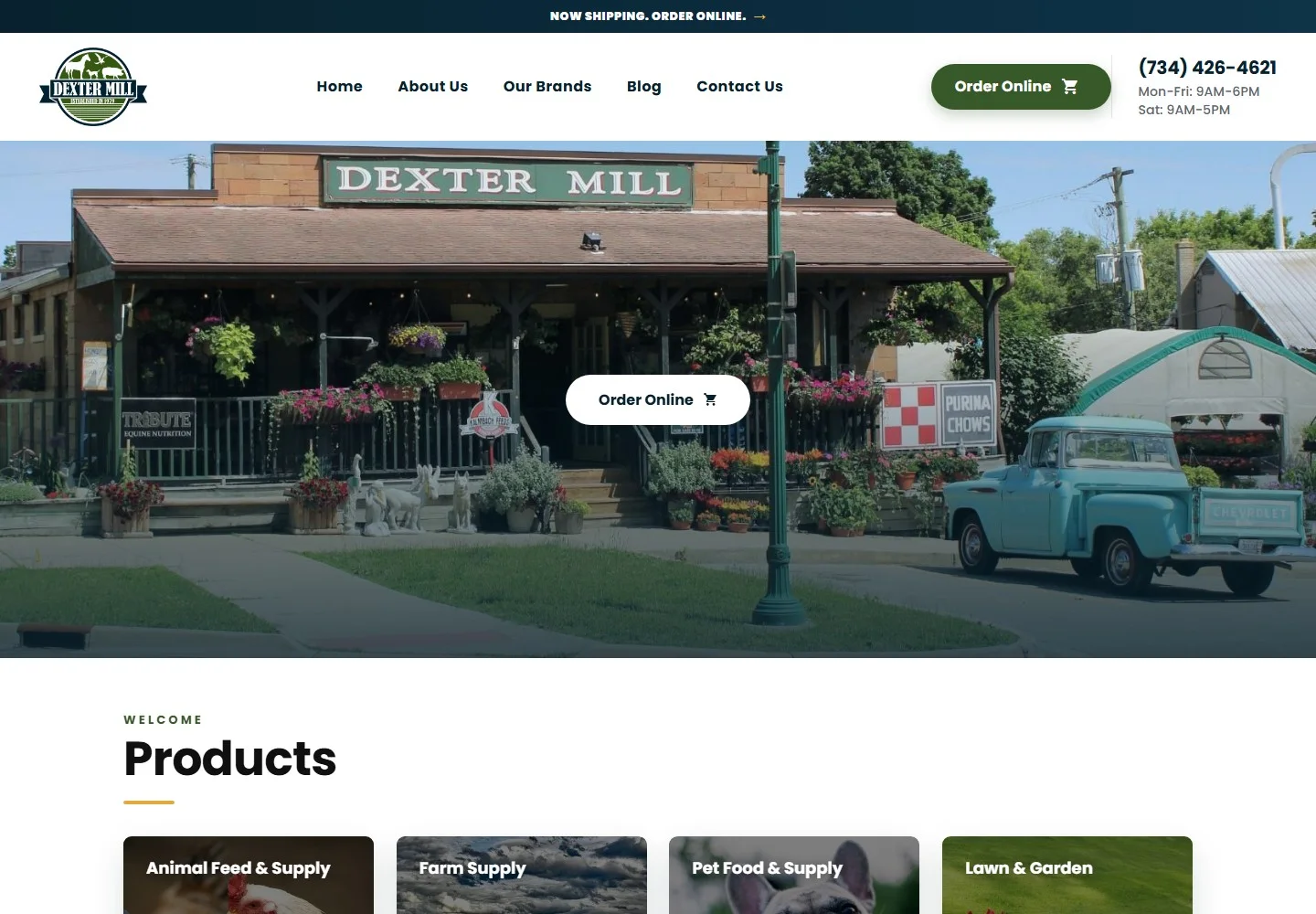
We rebuilt the site as a fully static architecture — preserving its content, URLs, and search presence while eliminating the server-side attack surface entirely. The new site deploys to Vercel's edge network behind a Cloudflare proxy with a web application firewall. When a DDoS attack hit in August 2026, the layered mitigation absorbed it and the site remained available. In November 2026 we refreshed the front end on the same static build, with a cleaner header that puts ordering and store hours one tap away, a new mobile menu, tighter typography and a simpler blog.
The outcome
- Eliminated the CMS attack surface that made the old site a recurring risk
- Survived a live DDoS attack with the site remaining available
- Faster page loads on edge hosting than the legacy server stack
- Front end refreshed in November 2026 with no change to URLs or hosting
Systems connected
What now talks to what.
- Legacy Joomla content (migrated)
- Cloudflare security layer
- Search presence preserved via full URL and redirect mapping
Want the same?
The services behind this project.
This project became our template for retiring legacy CMS sites: preserve every URL and every piece of content that earns traffic, remove the machinery that keeps getting attacked, and put real security layers in front of what remains. The most satisfying part wasn’t the launch — it was watching an actual attack bounce off.